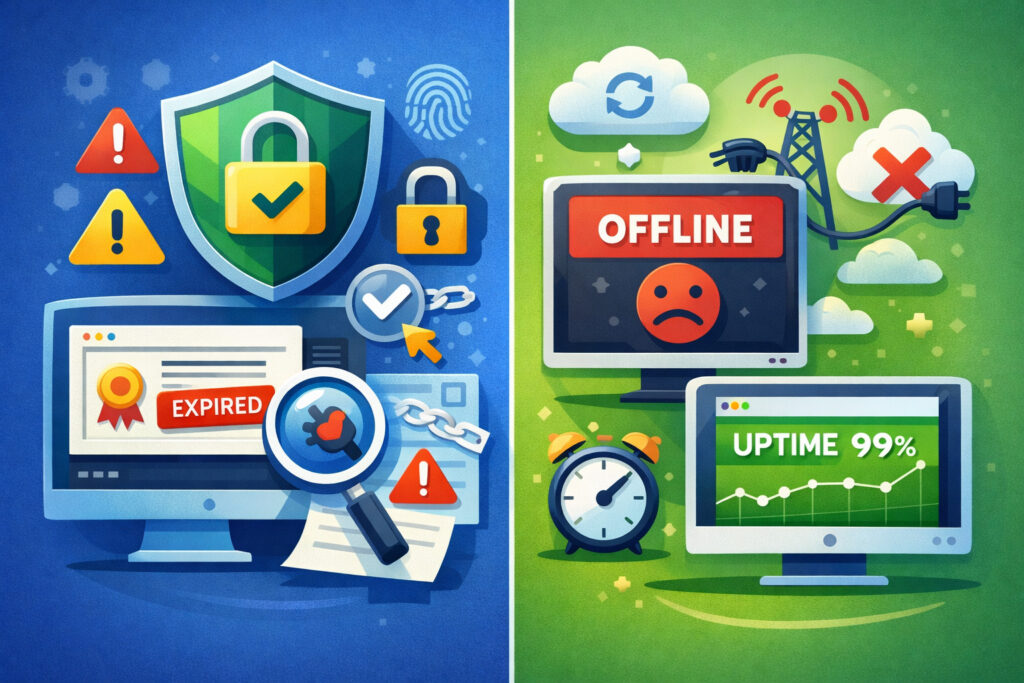
If you manage websites — whether your own or for clients — you’ve probably set up some form of uptime monitoring. A ping every few minutes, an alert when a server goes down. That’s good. But here’s the thing: SSL monitoring and website uptime monitoring are not the same thing, and confusing the two is one of the most common blind spots I see in otherwise solid infrastructure setups. Understanding the difference between SSL monitoring and uptime monitoring can save you from a category of outages that ping checks will never catch.
What Uptime Monitoring Actually Does
Uptime monitoring checks whether your server responds. That’s it. A typical uptime monitor sends an HTTP or ICMP request to your site every 30–60 seconds and flags you if it gets no response or a timeout.
It answers one question: ”Is the server reachable?”
This is essential, obviously. If your server crashes at 3 AM, you want to know immediately — not when your first customer emails you at 9 AM. But uptime monitoring has a significant blind spot. It doesn’t care about what your server sends back, only that it sends something back.
Your site can be ”up” with a 200 OK response and still be completely broken from a user’s perspective — because the SSL certificate expired two hours ago and every visitor sees a full-page browser warning.
What SSL Monitoring Covers That Uptime Monitoring Doesn’t
SSL monitoring is a fundamentally different layer. Instead of asking ”Is the server alive?”, it asks a series of much more specific questions:
Is the SSL certificate still valid, and when does it expire? Is the certificate chain complete and correctly ordered? Are there mixed content issues serving HTTP resources on an HTTPS page? Is HSTS configured properly? Are Certificate Transparency logs publishing as expected? Is OCSP stapling working? Does the certificate actually match the domain it’s serving?
None of these are things an uptime check will ever detect. I’ve seen production sites pass uptime checks with flying colors for weeks while silently serving a broken certificate chain that caused warnings in Firefox but not Chrome. The uptime monitor was happy. The customers were not.
A Scenario You’ve Probably Lived Through
Here’s a situation any sysadmin will recognize. You’ve got a Let’s Encrypt certificate set to auto-renew via certbot. Renewal cron job has been running fine for months. Then one day, a server update changes the cron environment, or a firewall rule blocks the ACME challenge, or the webroot path silently changes after a deploy.
The certificate expires. Your uptime monitor? Green across the board — the server is responding just fine. But every visitor now gets a ”Your connection is not private” warning. On an e-commerce site, that’s not an inconvenience. That’s revenue disappearing in real time.
If you’d had SSL monitoring with advance expiration alerts at 30, 14, 7, and 1 days, you’d have caught this before it ever reached a customer.
The Common Myth: ”My Uptime Monitor Checks HTTPS, So I’m Covered”
This is the misconception I want to bust directly. Yes, most uptime monitors can hit an HTTPS URL. But they typically accept any response — including responses served with expired, self-signed, or misconfigured certificates. Many monitoring tools deliberately ignore certificate errors to avoid false positives on the uptime side.
So your dashboard shows 99.9% uptime while your SSL has been broken for days. The metrics look great. The reality doesn’t.
SSL monitoring does the opposite. It specifically looks for certificate problems — expiration dates, chain issues, revocation status, protocol mismatches — and alerts you when something is wrong, even if the server itself is perfectly healthy.
Why You Need Both, Not One or the Other
This isn’t an either/or decision. They monitor different failure modes.
Uptime monitoring catches server crashes, network outages, DNS failures, and application errors that prevent any response. SSL monitoring catches certificate expirations, chain problems, mixed content, HSTS misconfigurations, transparency log anomalies, and protocol downgrades.
A site can be down with valid SSL. A site can be up with broken SSL. You need visibility into both.
Think of it this way: uptime monitoring tells you the building is standing. SSL monitoring tells you the locks on the doors actually work. Both matter if you’re running a business.
What to Look for in SSL Monitoring
A good SSL monitoring setup goes beyond just checking the expiration date. You want certificate chain validation, because an incomplete chain will break on some browsers and devices while working fine on others. You want mixed content detection to catch HTTP resources loaded on HTTPS pages. You want OCSP and Certificate Transparency monitoring for compliance and early breach detection.
SSLVigil, for example, produces a monthly security report grading your SSL setup from A+ to F — which gives you a single metric to track over time rather than chasing individual issues. That kind of consolidated view is something no uptime monitor provides.
FAQ
Can uptime monitoring replace SSL monitoring?
No. Uptime monitoring checks server availability, not certificate health. A site can pass every uptime check while serving an expired or misconfigured SSL certificate. You need dedicated SSL monitoring to catch certificate-specific issues.
How often should SSL certificates be monitored?
Daily checks are a reasonable minimum, with 24/7 monitoring being ideal for production sites. Certificate issues can appear suddenly — a failed auto-renewal, a revoked intermediate certificate — and the faster you detect them, the less impact they have.
Do I need SSL monitoring if I use Let’s Encrypt auto-renewal?
Absolutely. Auto-renewal is not infallible. DNS changes, firewall rules, server migrations, and permission errors can all silently break the renewal process. SSL monitoring acts as your safety net for when automation fails.
The Bottom Line
If you’re relying solely on uptime monitoring to keep your sites healthy, you’ve got a gap in your visibility. SSL failures are a distinct category of problem — invisible to ping checks, devastating to user trust, and entirely preventable with the right monitoring in place. Set up both. Your uptime monitor keeps the lights on. Your SSL monitor makes sure the front door isn’t wide open.