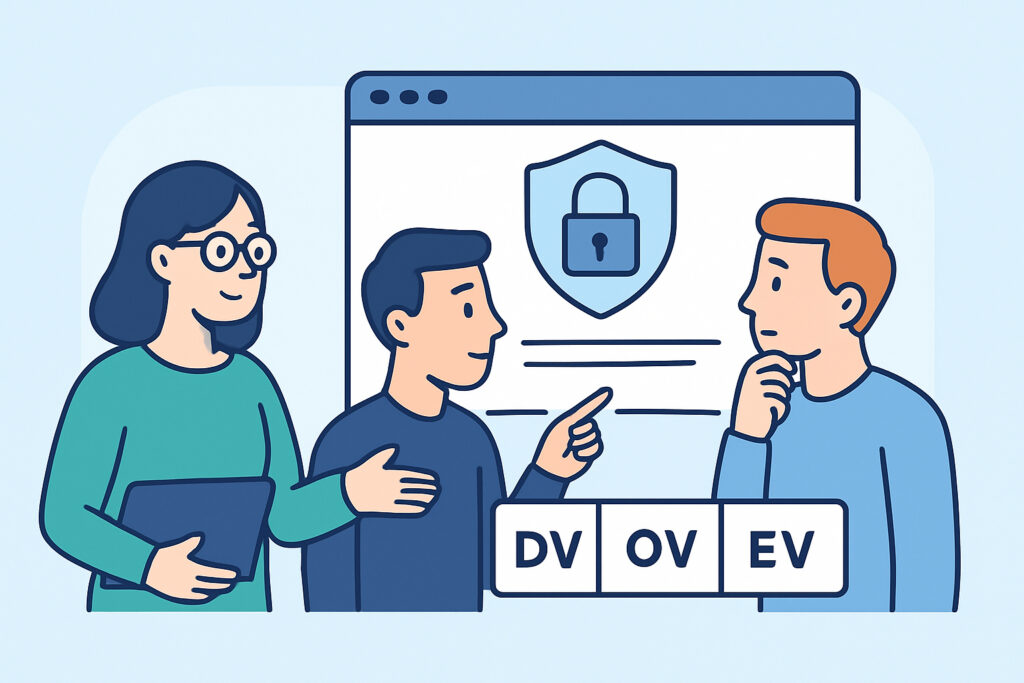
When choosing an SSL certificate for your website, understanding the difference between DV, OV, and EV SSL certificates is crucial for making the right security and business decision. These three validation levels offer different degrees of identity verification, visual indicators, and trust signals that can significantly impact your site’s credibility and user confidence.
SSL certificate validation levels determine how thoroughly a Certificate Authority verifies your identity before issuing the certificate. Each type serves different business needs, compliance requirements, and security postures.
Domain Validated (DV) SSL Certificates
DV certificates represent the most basic level of SSL validation. The Certificate Authority only verifies that you control the domain in question – nothing more. This verification typically happens through email confirmation, DNS record validation, or file upload to your web server.
The validation process usually completes within minutes or hours. You’ll receive an email at an administrative address (like admin@yourdomain.com), click a confirmation link, and the certificate gets issued automatically.
DV certificates display the standard padlock icon in browsers but show no company information in the certificate details. They’re perfect for blogs, personal websites, development environments, and small businesses where brand validation isn’t critical.
Let’s say a small consulting firm needs HTTPS for their simple WordPress site. A DV certificate provides the necessary encryption and SEO benefits without the overhead of business verification processes. The certificate will show “Secure” in browsers and encrypt all traffic, which satisfies most basic security requirements.
Organization Validated (OV) SSL Certificates
OV certificates require the Certificate Authority to verify both domain control and your organization’s legal existence. This involves checking business registration records, confirming your company’s physical address, and sometimes requiring phone verification.
The validation process typically takes 1-3 business days. You’ll need to provide business registration documents, and the CA will verify your organization exists in relevant government databases. Some CAs call your business phone number listed in public records.
OV certificates display your organization name in the certificate details when users click the padlock icon. This provides additional trust signals, especially for businesses handling sensitive customer data or operating in regulated industries.
A mid-sized e-commerce retailer might choose OV certificates because customers can verify the legitimate business name behind the website. When users inspect the certificate, they see “Verified Organization: Example Retail Inc.” instead of just domain information.
Extended Validation (EV) SSL Certificates
EV certificates require the most rigorous validation process. The Certificate Authority performs extensive verification of your legal, physical, and operational existence according to strict industry guidelines defined in the CA/Browser Forum’s EV Guidelines.
The validation process takes 1-2 weeks and includes verifying legal incorporation, confirming physical business address, checking that your organization has been operational for a specific period, and validating that you have exclusive rights to use the domain for business purposes.
Modern browsers no longer display the green address bar that made EV certificates famous. However, EV certificates still provide the highest level of identity assurance and are often required for compliance frameworks in banking, healthcare, and government sectors.
Many assume EV certificates provide stronger encryption than DV or OV certificates. This is completely false – all three validation levels use identical encryption algorithms and key lengths. The difference lies purely in identity verification, not cryptographic strength.
Choosing the Right DV, OV, or EV Certificate
Consider DV certificates for personal blogs, development sites, internal applications, or any scenario where quick deployment matters more than brand validation. They’re also perfect for automated certificate management using protocols like ACME with Let’s Encrypt.
Choose OV certificates for established businesses, customer-facing applications, or situations where showing verified company information adds credibility. They work well for corporate websites, business applications, and companies that want to display organizational identity without EV costs.
Select EV certificates only when compliance requirements mandate them or when maximum identity assurance provides clear business value. Financial institutions, large corporations, and high-value e-commerce sites often use EV certificates despite the reduced visual indicators in modern browsers.
Price considerations matter too. DV certificates cost $0-50 annually, OV certificates range from $50-200, while EV certificates typically cost $200-1000+ per year. Financial services organizations often justify EV costs through compliance requirements.
Technical Considerations for Certificate Management
All three validation levels support the same technical features: wildcard coverage, Subject Alternative Names (SANs), and identical encryption capabilities. Your choice shouldn’t be based on technical limitations but on business requirements.
Certificate renewal processes differ significantly. DV certificates can be fully automated, while OV and EV certificates require periodic re-validation of business information. This impacts your operational overhead and certificate management workflows.
Consider your monitoring requirements carefully. Automated SSL monitoring solutions work identically across all validation levels, but EV certificates’ longer validation times require more careful renewal planning to avoid expiration.
FAQ
Do EV certificates provide better security than DV certificates?
No, all SSL certificate types use identical encryption algorithms and provide the same level of data protection. The difference is in identity verification, not cryptographic security.
Can I upgrade from DV to OV without changing my certificate?
No, you need to purchase and install a new OV certificate. The validation level is embedded in the certificate during issuance and cannot be modified afterward.
How do browsers display different validation levels?
Modern browsers show a padlock icon for all valid SSL certificates. The organization name appears only in certificate details for OV and EV certificates, not in the address bar as it once did.
Making the Practical Choice
Most websites function perfectly with DV certificates, especially when combined with proper SSL monitoring and security practices. Focus on your actual business needs rather than perceived security benefits.
If customers need to verify your business identity, choose OV. If compliance mandates extended validation or your industry demands maximum identity assurance, invest in EV. Remember that regardless of validation level, proper certificate management and monitoring remain essential for maintaining continuous HTTPS security.