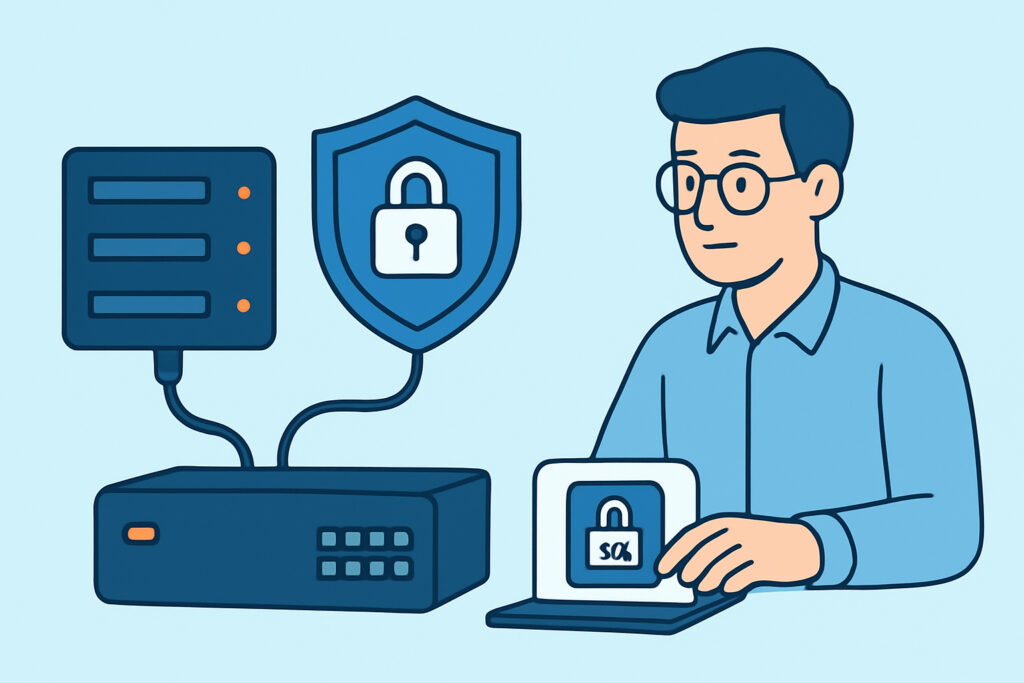
Moving TLS private keys into a hardware security module (HSM) is one of the strongest ways to keep them from being stolen, but it also changes how certificate renewal, monitoring and failover work. This article is for security engineers, platform teams and sysadmins weighing hardware security modules for SSL certificate storage. It explains what an HSM actually protects, when it is worth the cost, how to connect one to common web servers, and which mistakes cause outages after the hardware is in place.
What an HSM Actually Protects
An HSM is a tamper-resistant device that generates and stores cryptographic keys. It also performs operations with those keys, so the key never has to leave the hardware. When a web server holds its key in an HSM, the server never sees the key material. It sends signing requests through PKCS#11, Microsoft CNG or a vendor API, and the HSM sends back the result.
Here is a common misconception: an HSM does not store your SSL certificate in any meaningful security sense. The certificate is public. Every visitor receives it in the TLS handshake, and it is published in Certificate Transparency logs. The asset worth protecting is the private key. The certificate file can sit on disk, in Git or in a CDN configuration without any risk.
A second misconception is more dangerous. A key held in an HSM is not safe from an attacker who controls the host. Someone with root on the web server cannot copy the key, but they can keep asking the HSM to sign handshakes for as long as they have access. What the HSM guarantees is that the compromise ends when access ends. Without an HSM, a stolen key file works until the certificate expires or someone revokes it.
When Hardware Key Storage Is Worth It
The common choices are network appliances such as Thales Luna Network HSM 7, Entrust nShield 5c and Utimaco SecurityServer, and cloud options such as AWS CloudHSM, Azure Managed HSM and Google Cloud HSM. AWS CloudHSM costs about $1.45 per HSM-hour in us-east-1. AWS recommends at least two HSMs for high availability, which comes to roughly $2,100 per month before any traffic. On-premises appliances usually cost $20,000-60,000 per unit, plus support contracts.
That spend makes sense in a few situations. Under PCI DSS 4.0, an HSM gives strong evidence that keys are protected. Banks and payment processors often must use FIPS 140-3 Level 3 hardware. The NIST FIPS 140-2 validations moved to the historical list in September 2026, so new procurement should check for 140-3 certificates. Code signing already requires hardware: since June 2023, the CA/Browser Forum has required code signing keys to live in hardware certified to FIPS 140-2 Level 2 or Common Criteria EAL 4+.
The standard advice also has limits. A five-person team running a marketing site on a managed platform gains little from an HSM. Its real risks are an expired certificate and a forgotten DNS record, not someone pulling a key from memory. For teams like that, the basics in private key protection best practices remove most of the risk for almost no money. A YubiHSM 2, at about $650, fits small on-premises setups that need hardware-backed keys on a few servers. Air-gapped environments often run their internal CA root keys on offline HSMs and leave the TLS endpoint keys in software.
Connecting an HSM to Nginx, Apache and IIS
An experienced platform engineer starts with the toolchain. OpenSSL 3.x deprecated the old ENGINE interface. The current approach is the pkcs11-provider project, loaded through openssl.cnf. A typical rollout looks like this:
1. Install the vendor’s PKCS#11 library and confirm the server can reach the partition or slot with pkcs11-tool –list-objects.
2. Generate the key pair inside the HSM and mark it non-extractable. Never import a key that was created in software.
3. Create the CSR from the key in the HSM through the provider, then submit it to your CA.
4. Point the web server at a PKCS#11 URI such as pkcs11:token=web-prod;object=tls-2026 instead of a .key file.
5. Test a full handshake from outside the network, then remove every leftover software copy of the key.
Apache 2.4 with mod_ssl accepts PKCS#11 URIs directly in SSLCertificateKeyFile. Nginx support depends on how OpenSSL and the provider are built, so test it on the exact package version you deploy. IIS works through the vendor’s CNG Key Storage Provider. The certificate appears in the Windows store as usual, but its key is backed by the HSM.
Performance matters more than vendors suggest. Every full handshake adds a round trip to a network HSM. ECDSA P-256 keys need much less HSM capacity than RSA-3072. TLS session resumption and TLS termination on a smaller tier of front-end servers keep the number of HSM operations under control.
Renewal Gets Harder, Not Easier
Most automation tooling assumes the key is a file. Certbot and the default cert-manager setups generate a fresh key in software at every renewal. Once an HSM is involved, the renewal pipeline has to create a CSR from a key inside the hardware, either by reusing the existing key or by having the pipeline create a new key on the device.
This becomes a pressing problem now. Under CA/B Forum ballot SC-081, maximum certificate validity dropped to 200 days in March 2026, drops to 100 days in March 2027, and reaches 47 days in 2029. The timeline is covered in more detail in the 47-day certificate standard. A manual HSM renewal process that was acceptable once a year breaks down when it has to run eight times a year. Teams using cloud key stores face the same problem, and Azure Key Vault monitoring practices cover much of the same ground.
Common Mistakes with HSM-Backed Certificates
Losing track of the HSM’s own credentials. Network HSM clients usually authenticate to the appliance with their own client certificate, and the HSM partition has a password or PIN. Here is a scenario many sysadmins will recognize. The public certificate has 140 days left and every external check is green. Then the HSM client certificate created during installation three years earlier expires. Every web server loses its HSM connection at the same moment, and every handshake fails. Add those internal credentials to the same inventory and alerting as the public certificates.
Treating the HSM as the backup. If the only copy of a non-extractable key is on one appliance and that appliance fails, the key is gone. Clustering, or encrypted backup to a second HSM from the same vendor, has to exist before production traffic depends on the device.
Monitoring the hardware but not the endpoint. HSM dashboards report on partitions, temperature and operation counts. They do not show that a load balancer is still serving last year’s certificate, that the intermediate certificate is missing from the chain, or that OCSP stapling stopped working. External checks of expiration, chain correctness, HSTS and CT log entries still need to run on every public hostname.
FAQ
Do I need an HSM to get an A+ SSL grade?
No. SSL grades measure protocol versions, cipher suites, certificate chain correctness and headers such as HSTS. Where the key is stored does not affect the score.
Can I use an HSM with Let’s Encrypt certificates?
Yes. The ACME protocol only needs a CSR. Clients such as lego, or a custom script, can submit a CSR built from a key inside the HSM. You lose the convenience of automatic key generation at each renewal.
Is a cloud HSM as secure as an on-premises appliance?
AWS CloudHSM and Azure Managed HSM use FIPS 140-validated Level 3 hardware, and each customer gets dedicated key control. The difference is mostly about who has physical custody and which jurisdiction applies, not the strength of the cryptography.
Practical Takeaway
An HSM ends the risk of copied private keys and makes many compliance audits simpler. It does not prevent expiry, chain errors or misconfiguration. Before buying one, map out how renewal will work at 100-day and later 47-day validity periods. Add the HSM’s own certificates and PINs to your certificate inventory, and keep external endpoint monitoring running, because the HSM cannot see what visitors receive.