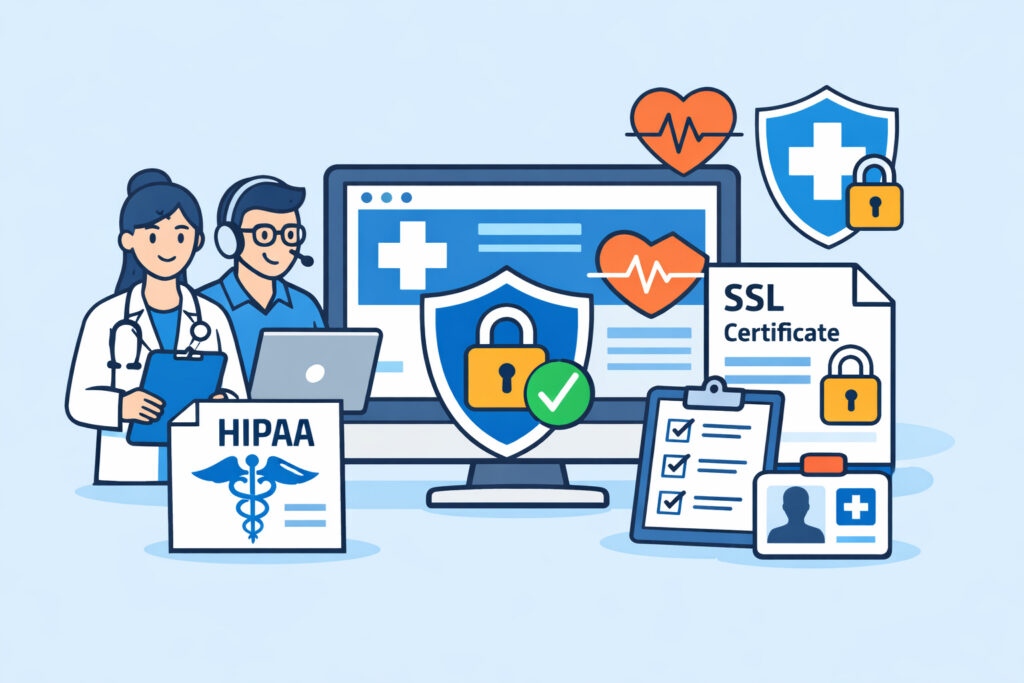
If you manage a healthcare website that handles patient data, SSL monitoring for healthcare websites isn’t optional – it’s a regulatory requirement. HIPAA demands that electronic protected health information (ePHI) is encrypted in transit, and a misconfigured or expired SSL certificate is one of the fastest ways to fall out of compliance. This guide covers exactly what healthcare organizations need to monitor, how SSL fits into HIPAA’s technical safeguards, and what steps you can take today to stay compliant without losing sleep.
Why SSL Monitoring Matters More in Healthcare
Every website benefits from proper SSL, but healthcare is a different beast. When a patient portal, telehealth platform, or appointment booking system loses its HTTPS protection – even for a few hours – you’re not just dealing with a browser warning. You’re potentially exposing ePHI, which triggers HIPAA’s Breach Notification Rule.
I’ve seen healthcare IT teams discover an expired certificate on a patient portal at 2 AM on a Saturday because a renewal reminder landed in a shared inbox nobody checks on weekends. By the time someone noticed, the portal had been serving insecure connections for nearly 18 hours. That’s 18 hours of unencrypted patient data in transit – and a reportable incident.
The financial exposure is real. HIPAA penalties range from $141 per violation up to $2.1 million per category per year, and the Office for Civil Rights doesn’t distinguish between a sophisticated cyberattack and a preventable certificate lapse. Both are compliance failures.
What HIPAA Actually Requires for Encryption in Transit
HIPAA’s Security Rule (§164.312(e)(1)) requires covered entities to implement technical security measures to guard against unauthorized access to ePHI transmitted over electronic networks. While the rule calls encryption an “addressable” specification rather than “required,” don’t let that terminology fool you.
Here’s the myth that trips people up: “Addressable” means optional. It doesn’t. Under HIPAA, “addressable” means you must either implement the specification or document why an equivalent alternative is reasonable. In practice, there is no reasonable alternative to TLS encryption for web-based systems in 2026. Every auditor and every OCR enforcement action treats unencrypted web transmissions of ePHI as a violation.
What this means for your SSL monitoring setup is straightforward. You need to verify that every endpoint handling ePHI maintains a valid, properly configured TLS certificate at all times – no gaps, no exceptions.
The SSL Monitoring Checklist for HIPAA Compliance
Healthcare organizations typically run more SSL-protected endpoints than they realize. Beyond your main website, think about patient portals, API endpoints for EHR integrations, telehealth video servers, payment processing pages, and email gateways. Each one needs monitoring.
Here’s what to track across all of them:
Certificate expiration. Set up alerts at 30, 14, 7, and 1 day before expiration. A single lapsed certificate on a forgotten subdomain can trigger a compliance review. Automated monitoring through a service like SSLVigil’s SSL certificate monitoring catches what manual spreadsheets miss.
Certificate chain integrity. An incomplete chain causes connection failures on certain devices and browsers – especially older mobile devices that patients commonly use. If your intermediate certificate is missing, some patients can’t connect securely, and their browsers may fall back to insecure behavior. Understanding how to detect and resolve certificate chain issues is essential for healthcare environments.
Protocol and cipher strength. HIPAA doesn’t specify TLS versions, but NIST guidelines (SP 800-52 Rev. 2) require TLS 1.2 as a minimum, with TLS 1.3 recommended. If your server still negotiates TLS 1.0 or 1.1, you’re both non-compliant and vulnerable.
HSTS enforcement. HTTP Strict Transport Security ensures browsers never attempt an insecure connection to your domain. For healthcare sites, this prevents downgrade attacks that could intercept ePHI during the initial connection.
Certificate Transparency log presence. CT logs provide a public audit trail that no unauthorized certificates have been issued for your domains – a real concern for healthcare organizations targeted by phishing campaigns.
Common Pitfalls Healthcare IT Teams Face
The biggest problem I see isn’t technology – it’s organizational. Healthcare IT environments are fragmented. The main website runs on one platform, the patient portal on another, telehealth on a third-party service, and the billing system on yet another vendor’s infrastructure. Nobody owns SSL monitoring across all of them.
This leads to blind spots. A vendor rotates their certificate and introduces a chain error. A DevOps engineer provisions a staging server with a self-signed certificate that accidentally goes live. A Let’s Encrypt auto-renewal fails silently because someone changed the DNS records.
Centralized monitoring solves this. When every endpoint – regardless of who manages the underlying infrastructure – reports into a single dashboard with consistent alerting, nothing falls through the cracks. Following SSL monitoring best practices is especially critical when patient data is at stake.
Building an Audit Trail for HIPAA Documentation
HIPAA requires covered entities to maintain documentation of their security measures. When an auditor asks how you ensure encryption in transit, “we check manually every few weeks” won’t satisfy them.
What auditors want to see is evidence of continuous monitoring, a documented alerting process, historical records showing certificate status over time, and proof that issues were detected and remediated promptly. Monthly SSL security reports with clear grading – like the A+ to F assessments SSLVigil delivers directly to your inbox – give you exactly this kind of documentation without extra effort.
Keep these reports archived alongside your other HIPAA compliance documentation. They demonstrate that your organization actively monitors encryption rather than treating it as a set-and-forget configuration.
What Happens When SSL Fails on a Healthcare Site
An expired or misconfigured certificate on a healthcare website creates a cascade of problems. Patients see browser warnings and either leave – damaging trust and potentially delaying care – or click through the warning, training them to ignore legitimate security alerts in the future.
From a compliance perspective, the security risks of expired SSL certificates are amplified in healthcare. Any period where ePHI was transmitted without encryption must be evaluated as a potential breach. If it affected more than 500 individuals, you’re required to notify HHS, the affected patients, and in some cases the media – within 60 days.
The reputational damage can be worse than the fine. Patients choose healthcare providers partly based on trust, and a publicized data incident erodes that trust in ways that take years to rebuild.
FAQ
Does HIPAA require a specific type of SSL/TLS certificate for healthcare websites?
No. HIPAA doesn’t mandate a particular certificate type (DV, OV, or EV). What matters is that the certificate is valid, properly configured, and uses strong encryption – TLS 1.2 or higher with recommended cipher suites per NIST guidelines. Many healthcare organizations prefer OV or EV certificates for patient-facing portals because they provide organizational identity verification, but this is a best practice rather than a regulatory mandate.
How often should healthcare organizations check their SSL certificate status?
Continuous automated monitoring is the standard for HIPAA compliance. Manual periodic checks – even daily ones – leave gaps where an issue could go undetected. Automated 24/7 monitoring with multi-stage expiration alerts ensures that certificate problems are caught and addressed before they create a compliance exposure.
Can a third-party SSL monitoring service access our patient data?
No. SSL monitoring services like SSLVigil only check the publicly visible aspects of your certificate – validity dates, chain integrity, protocol support, and security headers. They connect to your server the same way any browser would. No ePHI is accessed, transmitted to, or stored by the monitoring service, so there’s no need for a Business Associate Agreement for SSL monitoring alone.
A final practical tip: start by inventorying every domain and subdomain your organization uses that touches patient data. Include vendor-hosted services and internal tools. Feed that complete list into your SSL monitoring setup, and review the results monthly alongside your other HIPAA security reviews. The organizations that get caught by expired certificates are almost always the ones that didn’t know about every endpoint they were running.