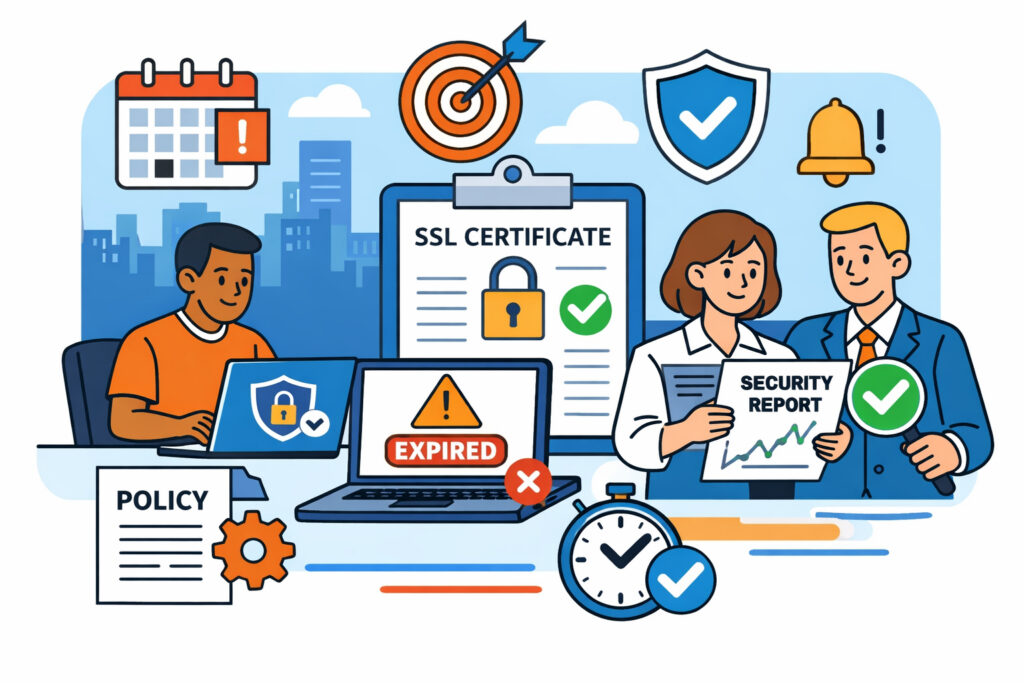
If you’re responsible for keeping a website – or dozens of them – running smoothly, you already know that SSL certificates aren’t something you set up once and forget. Proactive SSL certificate management is the difference between a quietly humming infrastructure and a 3 AM phone call about lost revenue. This article breaks down exactly why treating SSL as a business priority pays off, and how to build a case your leadership team will actually listen to.
What Happens When SSL Management Is Reactive
Let’s paint a picture most sysadmins will recognize. A certificate expires on a Friday evening. Nobody catches it until Monday morning when customer support starts forwarding screenshots of browser warnings. By then, your site has been showing “Your connection is not private” for over 60 hours. Organic traffic has dropped. A handful of customers have already emailed competitors.
This isn’t a worst-case scenario – it’s an ordinary one. Reactive SSL management means you only deal with certificates after something breaks. The cost isn’t just technical. It’s reputational, financial, and often invisible until you dig into the numbers.
A single expired certificate on a checkout page can tank conversion rates for days, even after the fix is live. Visitors who saw that warning may not come back. Google may temporarily suppress your rankings while it re-evaluates your site’s trustworthiness. These aren’t hypothetical risks – they’re measurable business losses.
The Real Cost of SSL Downtime
Most organizations underestimate what an SSL incident actually costs. Here’s a rough framework for calculating it:
Direct revenue loss – if your site generates €10,000/day, even a 6-hour outage during peak hours could mean €2,500+ gone. For e-commerce, the number scales fast during seasonal peaks.
Recovery time – renewing a certificate takes minutes. Diagnosing a chain issue, clearing HSTS caches, waiting for CDN propagation, and getting re-indexed by Google? That can stretch into days.
Staff cost – every hour your team spends firefighting an SSL incident is an hour not spent on planned work. If three engineers spend half a day on it, that’s easily €1,000–€1,500 in labor.
Brand damage – the hardest to quantify, but often the most expensive. A security warning tells your visitors that you don’t take their safety seriously. For SaaS companies and financial services, one visible lapse can undo months of trust-building.
Busting the “Auto-Renewal Handles Everything” Myth
Here’s a misconception that catches teams off guard constantly: “We use Let’s Encrypt with auto-renewal, so we’re covered.”
Auto-renewal is great – until it silently fails. DNS changes, server migrations, expired ACME account keys, rate limits, firewall changes blocking validation – any of these can break the renewal process without triggering an obvious alert. I’ve seen environments where auto-renewal had been failing for weeks, and nobody noticed until the certificate actually expired.
Proactive management means monitoring whether renewal actually succeeded, not just assuming it did. It means tracking certificate expiration dates independently of whatever automation you’re running. A monitoring layer like SSLVigil that sends advance warnings at 30, 14, 7, and 1 day before expiration catches exactly these silent failures – the ones your automation was supposed to handle but didn’t.
Building the Business Case for Your Team
If you need to justify the investment in proactive SSL management to stakeholders, here’s what works.
Quantify the risk. Pull your site’s average daily revenue or lead volume. Estimate the cost of even a 12-hour SSL outage. Compare that number to the cost of a monitoring solution. The ROI of automated SSL monitoring typically becomes obvious the moment you put real revenue figures next to it.
Show the complexity. List every certificate your organization manages – including subdomains, wildcard certs, third-party integrations, and API endpoints. Most companies are surprised by the actual count. Managing 5 certificates manually is feasible. Managing 50 across multiple servers, CDNs, and environments is a different problem entirely.
Highlight compliance requirements. If your organization handles payment data (PCI DSS), health records (HIPAA), or operates in the EU under GDPR, SSL management isn’t optional – it’s auditable. Proactive monitoring gives you documentation, monthly security reports, and a clear audit trail. SSLVigil’s graded reports (A+ to F) provide exactly the kind of evidence compliance teams need.
Compare approaches. Some teams try to build monitoring internally – a cron job that checks expiration dates, maybe a Nagios plugin. This works until it doesn’t. Internal solutions require maintenance, don’t usually cover chain validation or OCSP issues, and lack centralized reporting. The comparison between in-house and automated solutions almost always favors dedicated tooling once you account for total cost of ownership.
What Proactive SSL Management Actually Looks Like
Moving from reactive to proactive isn’t complicated, but it does require a shift in mindset. Here’s what a solid proactive approach includes:
Centralized visibility – one dashboard showing every certificate, its expiration date, chain status, and security grade. No more spreadsheets, no more “I think that one renews in April.”
Multi-stage alerting – not just one email the day before expiration, but a graduated series of warnings that give you time to act calmly instead of scrambling.
Chain and protocol monitoring – catching issues like intermediate certificate problems, weak cipher suites, missing HSTS headers, and Certificate Transparency anomalies before they become user-facing errors.
Monthly reporting – automated security reports that you can share with management, clients, or auditors without spending time compiling them yourself.
This is exactly what SSLVigil is built for. It handles monitoring, alerting, chain analysis, HSTS compliance, and reporting in one service – whether you manage a single domain or hundreds. The point is to make SSL something you review monthly, not something that wakes you up at night.
Why This Matters for Business Continuity
SSL isn’t just a security feature – it’s infrastructure. When it fails, everything downstream is affected: user trust, SEO performance, payment processing, API integrations, and partner confidence. Treating SSL certificate management as a business continuity concern – rather than a purely technical task – is the key shift that separates organizations that get surprised from those that don’t.
FAQ
How much does an SSL certificate outage actually cost a business?
It depends on your revenue model and traffic volume, but even a small e-commerce site generating €5,000/day can lose thousands from a single weekend outage – factoring in lost sales, recovery labor, and temporary SEO impact. Larger organizations often see five-figure losses from a single incident.
Isn’t auto-renewal enough to prevent SSL issues?
Auto-renewal handles the common case well, but it fails silently more often than most teams realize. DNS changes, server migrations, and validation failures can all break the process. Independent monitoring is the safety net that catches what automation misses.
What’s the fastest way to start proactive SSL management?
Begin by inventorying every certificate your organization uses – don’t forget subdomains, staging environments, and API endpoints. Then set up a monitoring service like SSLVigil that provides multi-stage expiration alerts, chain validation, and monthly graded reports. Most teams can go from zero visibility to full coverage in under an hour.
The bottom line is simple: proactive SSL certificate management costs a fraction of what a single incident costs. The business case practically writes itself – you just need to put the numbers on the table.