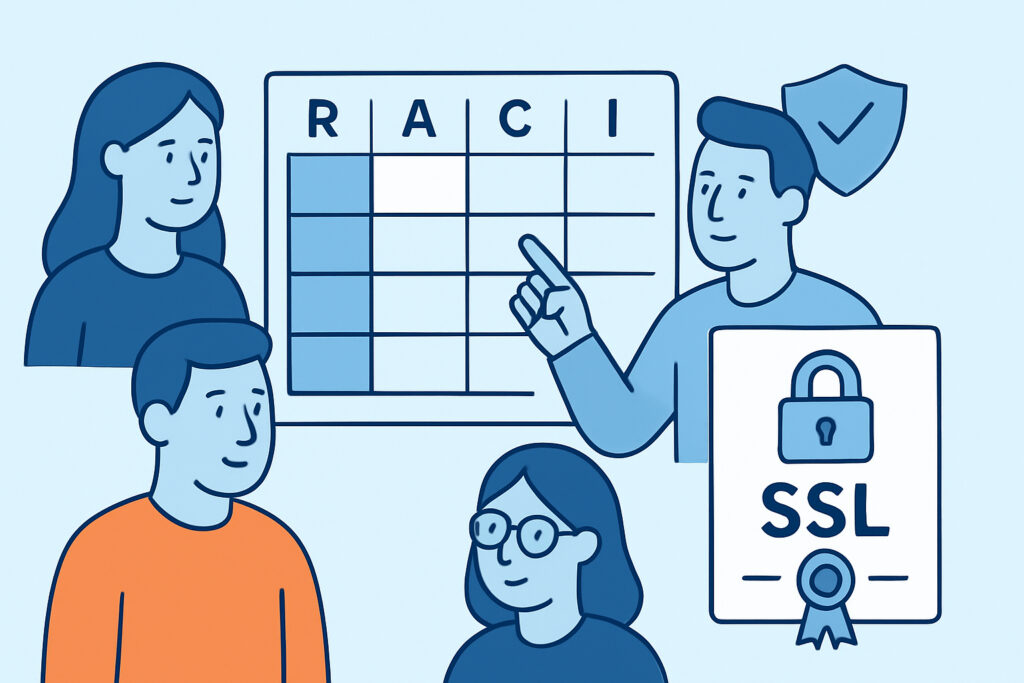
A certificate expires on a Saturday night, the on-call engineer gets paged, and nobody can say who was supposed to renew it – the DevOps lead thought the security team owned it, security thought it was automated, and the vendor contract expired along with the cert. A RACI matrix for SSL certificate management fixes exactly this kind of ownership gap by naming who is Responsible, Accountable, Consulted, and Informed for every step from issuance to revocation.
This isn’t a theoretical exercise for enterprises with dedicated PKI teams. Any organization running more than a handful of domains – 15, 50, 200 – eventually hits the same failure mode: a certificate task falls into a gap between two teams, and each assumes the other has it covered. A RACI matrix closes that gap on paper before it costs you an outage.
What a RACI matrix actually solves for SSL certificates
RACI stands for Responsible (does the work), Accountable (owns the outcome and signs off), Consulted (gives input before a decision), and Informed (told after the fact). Applied to certificate management, it maps each lifecycle stage – procurement, installation, monitoring, renewal, revocation, incident response – to a specific role, not a specific person.
That distinction matters. People change jobs. Roles persist. If your matrix says “Maria Kowalski renews the checkout.example.com cert,” you have a single point of failure the day Maria takes PTO or leaves the company. If it says “the Payments Platform Engineer is Responsible for renewal,” the matrix survives staff turnover.
The other thing a RACI matrix solves is duplicate effort disguised as redundancy. Teams often believe two groups both “own” SSL, which sounds safer but usually means neither actually checks – each assumes the other did. A properly built matrix has exactly one Accountable role per task, even when several roles are Consulted or Informed.
Building the matrix: the six stages worth mapping
A workable RACI table for certificate management typically covers these stages, each as its own row:
Procurement and CA selection – who chooses the certificate authority, validation level (DV, OV, EV), and validity period.
Installation and configuration – who deploys the cert to the server, load balancer, or CDN, and verifies chain correctness.
Monitoring and alerting – who watches expiration dates, HSTS status, and OCSP/CT compliance day to day.
Renewal execution – who actually triggers or approves the renewal, manual or automated.
Revocation and incident response – who acts when a key is compromised or a cert needs emergency replacement.
Audit and reporting – who reviews the monthly security posture and reports up to leadership or auditors.
For each row, assign exactly one Accountable owner. In most mid-sized organizations, that’s a platform engineering lead for installation and renewal, a security engineer or CISO for revocation and audit, and a DevOps or SRE role for day-to-day monitoring. Smaller teams often collapse two or three of these into one person – that’s fine, as long as it’s written down rather than assumed.
Where teams get this wrong
The most common mistake is writing “IT team” or “DevOps” into a cell instead of a named role. A team is not accountable for anything – a single person or role, on a given rotation, is. When an auditor or an incident postmortem asks “who was accountable for this renewal,” the answer needs to be a title, not a department.
A second mistake is treating the matrix as a one-time deliverable. Org charts change, teams get reorganized, someone moves from platform engineering to security. A RACI matrix that isn’t reviewed at least twice a year drifts out of sync with reality within about 12 months, and by then it’s actively misleading rather than merely stale.
The third mistake, and the one that causes actual outages, is confusing “Informed” with “Responsible.” A common pattern: security gets an automated Slack notification 30 days before expiration and assumes that counts as ownership being handled. It doesn’t. Being informed is not the same as being accountable for renewal, and if the matrix doesn’t distinguish the two, everyone assumes someone else is acting on the alert.
A seasoned platform lead treats the monitoring row differently from the renewal row on purpose – the person who sees an alert first is rarely the same person with authority to push a change to a production load balancer, and conflating the two is how 30-day warnings turn into Saturday night pages. Building a proper certificate inventory first makes this much easier, because you can’t assign ownership to certificates you don’t know exist.
Automation doesn’t remove the need for a RACI matrix
There’s a persistent myth that once renewal is automated – via ACME, Let’s Encrypt, or a cloud-native certificate manager – the ownership question disappears. It doesn’t. Automation removes manual renewal, not accountability for the system that performs it. Someone still needs to own the automation pipeline itself, respond when it fails silently, and verify the renewed certificate actually deployed correctly across every load balancer and CDN edge node.
Automated renewal failures are actually harder to catch than manual ones, precisely because nobody expects them. A cert that renews itself for two years straight builds false confidence, and when the automation breaks – an expired API token, a DNS validation record that got deleted, a rate limit hit – the team often has no manual fallback process because they never needed one. Mapping “who is Accountable when automated renewal fails” into the matrix, and tying it into your broader incident response plan, closes that gap.
Once ownership is defined, the reporting layer needs to reach the right audience too. Technical alerts about chain issues mean little to a compliance manager, while a monthly A-to-F grade summary is exactly what non-technical stakeholders in the Informed column actually need – which is its own design problem worth solving separately when you configure alerts for non-technical teams.
FAQ
How often should a certificate RACI matrix be reviewed?
Every six months at minimum, and immediately after any team reorganization, new hire in a certificate-adjacent role, or departure of someone named as an Accountable owner. Treat it like an on-call rotation document, not a one-time policy PDF.
Who should be Accountable for certificate renewal in a small team?
In teams under 10 people, one person – often the sole DevOps or infrastructure engineer – frequently holds Accountable status for procurement, installation, and renewal simultaneously. That’s acceptable as long as a backup is named for coverage during absences, and the role is documented rather than left as tribal knowledge.
Does a RACI matrix apply differently to internal versus public-facing certificates?
Yes. Public-facing certificates usually need faster escalation paths and often fall under compliance frameworks like PCI DSS or HIPAA, pulling in a GRC or compliance lead as Consulted or Accountable. Internal systems typically have longer tolerance for delay and can route through a single infrastructure owner without additional sign-off.
Certificate expirations rarely happen because nobody could renew the cert in time – they happen because everyone assumed someone else already had. A RACI matrix, reviewed on a fixed schedule and tied to roles rather than names, is one of the cheapest fixes available for that specific failure mode.