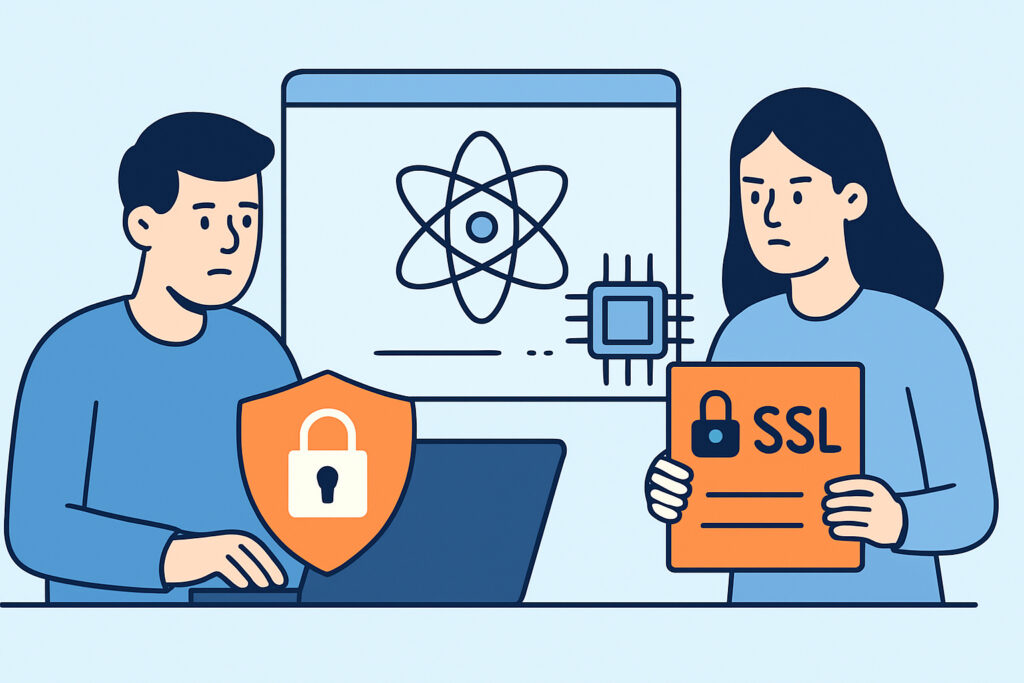
The impact of quantum computing on SSL certificate security is one of the most significant long-term challenges facing web infrastructure teams today. While quantum computers capable of breaking modern encryption don’t exist yet, the window for preparation is shorter than most organizations realize – and the decisions made now will determine how exposed those systems are when the threat matures.
Why Current SSL/TLS Encryption Is Vulnerable
Most SSL certificates in use today rely on RSA or ECC (Elliptic Curve Cryptography) for key exchange and authentication. These algorithms are computationally hard for classical computers to break – factoring a 2048-bit RSA key would take millions of years with today’s hardware.
A sufficiently powerful quantum computer changes that equation entirely. Shor’s algorithm, designed specifically for quantum hardware, can factor large integers and solve discrete logarithm problems exponentially faster than classical methods. Applied to a 2048-bit RSA key, a capable quantum computer could theoretically break it in hours or days, not millennia.
ECC, which is popular precisely because it offers strong security with shorter key sizes, is similarly vulnerable. The same mathematical problem underlying its security – the elliptic curve discrete logarithm – can be solved efficiently with Shor’s algorithm.
The Harvest Now, Decrypt Later Threat
Here’s the part that makes quantum risk immediate rather than theoretical: adversaries don’t need to break encryption in real time. They can capture encrypted traffic today and store it, waiting until quantum hardware is capable enough to decrypt it later.
This “harvest now, decrypt later” strategy is already in practice. State-level actors with long-term intelligence objectives are the obvious candidates, but the same principle applies to any organization whose sensitive data has a long shelf life – healthcare records, financial transactions, government communications, intellectual property.
A sysadmin securing a hospital’s patient portal today might assume that the TLS 1.3 handshake provides sufficient protection. But if that traffic is being intercepted and stored, the protection only lasts as long as RSA or ECC remains computationally hard – which, under quantum assumptions, may be less than two decades.
How Symmetric Encryption Fares – But Not Perfectly
Not all of your TLS stack is equally exposed. Symmetric encryption algorithms like AES-256 are affected by a different quantum algorithm – Grover’s algorithm – which provides a quadratic speedup in brute-force search. For AES-256, this effectively halves the security level to roughly 128 bits.
That’s still considered secure for most threat models. AES-128, however, drops to a roughly 64-bit effective security level under Grover’s attack, well within the range of exhaustion. Weak cipher suites that rely on shorter key lengths are already a liability today and will become untenable in a post-quantum environment.
The practical implication: TLS cipher negotiation matters more than ever. Environments that haven’t audited their cipher suite configurations are accumulating risk on two fronts simultaneously.
Post-Quantum Cryptography: What’s Actually Coming
The response to quantum risk has been underway for years. NIST finalized its first set of post-quantum cryptography (PQC) standards in 2024, including:
ML-KEM (Module-Lattice-based Key Encapsulation Mechanism, formerly CRYSTALS-Kyber) – for key exchange
ML-DSA (Module-Lattice-based Digital Signature Algorithm, formerly CRYSTALS-Dilithium) – for digital signatures
SLH-DSA (Stateless Hash-Based Digital Signature Algorithm, formerly SPHINCS+) – as a hash-based signature alternative
These algorithms are based on mathematical problems that remain hard for both classical and quantum computers – primarily lattice problems and hash functions. Browser vendors, certificate authorities, and server software maintainers are already beginning integration work.
TLS as a protocol is expected to support hybrid key exchange – combining classical and post-quantum algorithms simultaneously – as a transitional approach, so that even if one algorithm is compromised, the other still provides protection. Google and Cloudflare have already run production experiments with hybrid TLS using X25519+Kyber in real-world deployments.
The Myth That Slows Down Preparation
The most common misconception is that quantum risk only matters to government agencies, financial institutions, or critical infrastructure operators. In reality, any organization that transmits data with a long sensitivity horizon should be preparing now.
A secondary myth worth addressing: that upgrading to post-quantum algorithms is as simple as swapping a certificate. It isn’t. Certificate issuance, key exchange, TLS handshake negotiation, and application-level signature verification all touch the cryptographic layer. Migration requires coordinated changes across CA trust chains, server configuration, load balancers, CDN settings, and sometimes application code. Teams that treat this as a last-minute certificate swap will be caught off guard.
Steps to Take Before Post-Quantum TLS Is Mainstream
The preparation window is real and finite. Practical steps for any operations team:
1. Audit current cipher suites. Identify all endpoints running TLS and check which key exchange and signature algorithms are in use. Flag anything using RSA-1024, DHE with short keys, or ECDH curves below 256 bits.
2. Eliminate weak symmetric ciphers. Remove AES-128-CBC and similar configurations from your allowed cipher list. Prioritize AES-256-GCM and ChaCha20-Poly1305.
3. Inventory long-lived data flows. Identify which systems transmit data that needs to stay confidential for 10 or more years. These are your highest-priority migration targets for post-quantum key exchange.
4. Follow CA and browser vendor timelines. Certificate authorities will eventually offer PQC-based certificates. Watch for NIST-based OIDs appearing in trust store updates and plan staging tests accordingly.
5. Test hybrid TLS where available. Nginx and OpenSSL have experimental PQC support. Running hybrid configurations in staging now surfaces compatibility issues before production rollout under pressure.
6. Maintain continuous certificate and configuration monitoring. SSL monitoring best practices that include algorithm tracking will become essential as the migration progresses – knowing what’s deployed where, and whether any endpoints have drifted back to legacy configurations, is the operational foundation for a safe transition.
Frequently Asked Questions
Are current SSL certificates already broken by quantum computers?
No – no publicly known quantum computer has the qubit count or error correction needed to run Shor’s algorithm against real-world RSA or ECC keys. The risk is forward-looking, but the harvest-now-decrypt-later threat means preparation should start well before the hardware arrives.
Will I need to replace all my SSL certificates when post-quantum TLS becomes standard?
Yes, eventually. Certificate issuance will need to shift to post-quantum signature algorithms, and existing certificates signed with RSA or ECDSA will be phased out – similar to how SHA-1 certificates were deprecated over several years. The transition will likely happen in stages, not as a single cutover event.
Does TLS 1.3 protect against quantum attacks?
TLS 1.3 improves forward secrecy significantly, which limits exposure from session key compromise. But the underlying key exchange algorithms – primarily ECDHE – are still vulnerable to Shor’s algorithm. TLS 1.3 is the right baseline for today, not the final answer for a post-quantum environment.
Summary
The quantum threat to SSL certificate security is not a distant abstraction. RSA and ECC – the algorithms protecting most HTTPS traffic today – will eventually be broken by sufficiently capable quantum hardware, and the harvest-now-decrypt-later model means sensitive traffic is already being targeted for future decryption. Post-quantum cryptography standards now exist, and the migration path – while complex – is taking shape. Operations teams that start auditing cipher configurations, identifying sensitive data flows, and tracking post-quantum developments now will be in a far stronger position than those waiting for the industry to force the issue.