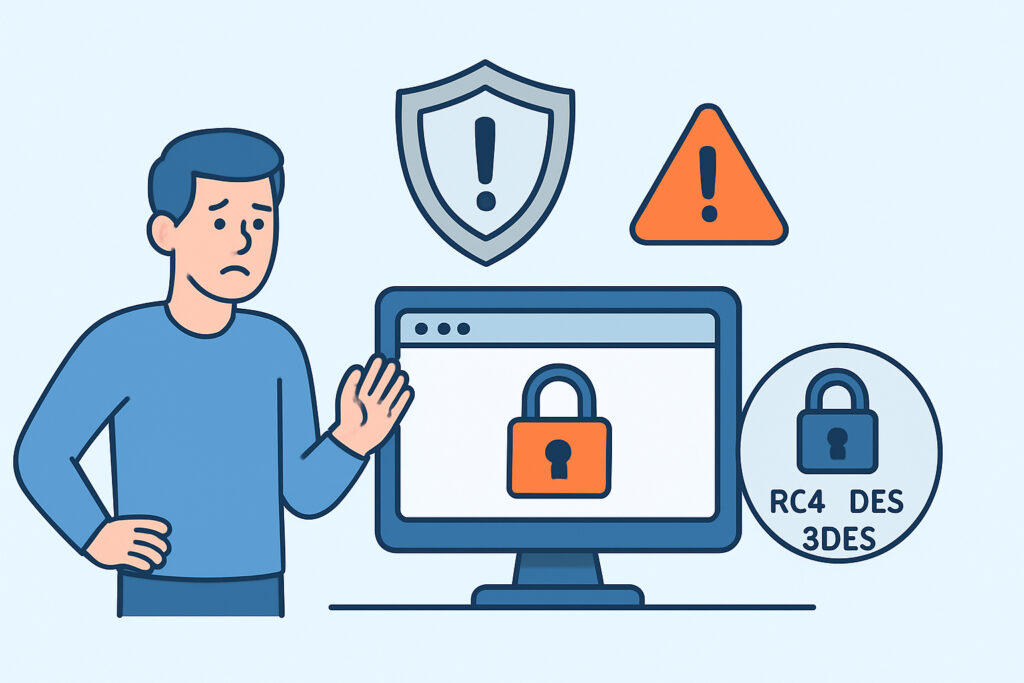
Weak SSL cipher suites create dangerous security vulnerabilities that expose sensitive data to cybercriminals and compliance violations. Understanding how these outdated cryptographic protocols threaten your website helps you identify and eliminate risks before they compromise customer trust and business operations.
This comprehensive guide examines the technical dangers of weak SSL cipher suites, explains how attackers exploit them, and provides actionable strategies to strengthen your website’s cryptographic security.
What Makes SSL Cipher Suites Weak
SSL cipher suites define the cryptographic algorithms used during HTTPS connections. A cipher suite contains four components: key exchange algorithm, authentication method, encryption algorithm, and message authentication code.
Weak cipher suites typically suffer from one or more fatal flaws. Outdated encryption algorithms like RC4 or DES use insufficient key lengths that modern computers can crack within hours. Poor key exchange methods such as static RSA lack forward secrecy, meaning compromised private keys expose all past communications.
Authentication weaknesses appear in cipher suites using MD5 hashing, which attackers can easily forge. Export-grade ciphers, originally weakened for 1990s export regulations, remain dangerously vulnerable despite their historical purpose ending decades ago.
A common misconception suggests that any SSL certificate provides adequate security. Reality proves different – certificates only establish identity, while cipher suites control the actual cryptographic strength protecting data transmission.
How Attackers Exploit Cipher Suite Vulnerabilities
Cybercriminals use several attack vectors against weak cipher suites. Downgrade attacks trick servers into accepting weaker encryption by manipulating the initial handshake negotiation. The attacker positions themselves between client and server, intercepting and modifying cipher suite preferences.
Consider a scenario where an e-commerce website supports both strong AES-256 and weak RC4 encryption. An attacker intercepts the connection attempt and removes strong cipher options from the client’s proposal. The server, maintaining backward compatibility, accepts RC4 encryption.
The attacker then exploits RC4’s statistical biases to recover encryption keys. Within hours, they decrypt payment card data, login credentials, and personal information transmitted during the session.
BEAST and CRIME attacks target specific cipher implementation flaws. BEAST exploits cipher block chaining weaknesses in older TLS versions, while CRIME attacks compress data to reveal secrets through compression ratio analysis.
Real-World Consequences of Weak Cipher Suites
Organizations face severe consequences when weak cipher suites compromise their security posture. Financial institutions lose customer trust when attackers decrypt sensitive banking communications. Healthcare providers violate HIPAA compliance requirements, triggering regulatory penalties and legal liability.
Data breach costs extend beyond immediate incident response. Companies spend months rebuilding customer confidence, implementing security improvements, and managing reputation damage. Average breach costs include forensic investigations, legal fees, regulatory fines, and customer notification expenses.
Business operations suffer during cipher suite attacks. Website performance degrades as security teams implement emergency fixes. Customer transactions fail when browsers display security warnings about weak encryption. Revenue drops as visitors abandon shopping carts due to security concerns.
Insurance companies increasingly scrutinize cryptographic practices when evaluating cyber liability claims. Policies may exclude coverage for incidents involving known weak cipher suites that organizations failed to address.
Identifying Vulnerable Cipher Suites on Your Website
Regular cipher suite assessment prevents security gaps from endangering your website. SSL Labs’ SSL Server Test provides comprehensive cipher suite analysis, revealing which algorithms your server supports and their relative security strength.
Run the test by entering your domain name and waiting for the detailed security report. The results highlight weak cipher suites in red, acceptable options in yellow, and strong configurations in green. Pay special attention to the cipher suite order – servers typically prefer the first option in their configuration list.
Command-line tools offer deeper technical analysis. OpenSSL’s s_client command tests specific cipher suites:
“`
openssl s_client -connect yourdomain.com:443 -cipher RC4-SHA
“`
If the connection succeeds, your server accepts the weak RC4-SHA cipher suite. Repeat testing with various weak ciphers to identify all vulnerabilities.
SSL security grades directly reflect cipher suite strength. Websites supporting weak encryption receive lower grades, impacting search rankings and user trust.
Configuring Strong Cipher Suites
Modern cipher suite configuration requires disabling weak algorithms while maintaining browser compatibility. Prioritize cipher suites offering perfect forward secrecy, such as ECDHE-RSA-AES256-GCM-SHA384 and ECDHE-RSA-AES128-GCM-SHA256.
Apache server configuration requires editing the SSLCipherSuite directive in your virtual host or main configuration file:
“`
SSLCipherSuite ECDHE+AESGCM:ECDHE+AES256:ECDHE+AES128:!aNULL:!MD5:!DSS:!RC4:!EXPORT
SSLHonorCipherOrder on
“`
Nginx configuration uses the ssl_ciphers directive:
“`
ssl_ciphers ECDHE+AESGCM:ECDHE+AES256:ECDHE+AES128:!aNULL:!MD5:!DSS:!RC4:!EXPORT;
ssl_prefer_server_ciphers on;
“`
Cloud load balancers and CDN services offer cipher suite management through web interfaces. AWS Application Load Balancer provides predefined security policies removing weak ciphers. Cloudflare automatically optimizes cipher suites but allows manual override for specific requirements.
Test configuration changes thoroughly before production deployment. Some older clients may lose connectivity when servers disable legacy cipher suites. Balance security requirements against user access needs.
Monitoring Cipher Suite Changes and Threats
Cipher suite security requires ongoing monitoring as new vulnerabilities emerge and attack techniques evolve. Automated SSL monitoring systems track configuration changes and alert administrators to potential weaknesses.
Monthly security assessments catch configuration drift and unauthorized changes. Development teams sometimes enable weak ciphers during testing and forget to remove them before production deployment. Regular monitoring prevents these temporary changes from becoming permanent vulnerabilities.
Browser updates frequently deprecate weak cipher suites, potentially breaking website compatibility. Monitor browser vendor announcements and security bulletins to understand timeline impacts on your cipher suite configuration.
Certificate transparency logs reveal when certificates support weak encryption algorithms. Monitoring these logs helps identify potential attacks targeting your domain through fraudulent certificates with intentionally weak cipher suites.
Compliance Requirements for Cipher Suite Security
Industry regulations mandate specific cipher suite security standards. PCI DSS requires strong cryptography for credit card data protection, explicitly prohibiting SSL/early TLS versions and weak cipher suites. Version 4.0 updates strengthen these requirements further.
HIPAA security rules require appropriate encryption for protected health information transmission. While not specifying exact cipher suites, the regulation demands industry-standard cryptographic protection against known attack methods.
Government websites must comply with NIST guidelines recommending specific cipher suite families. Federal agencies face additional requirements under Federal Information Security Management Act (FISMA) compliance frameworks.
Regular compliance audits assess cipher suite configurations against current standards. Auditors use automated tools to identify weak encryption and document findings in official reports. Failed audits trigger remediation requirements and potential service restrictions.
Frequently Asked Questions
How often should I review my website’s cipher suite configuration?
Review cipher suites monthly and immediately after any server configuration changes. New vulnerabilities emerge regularly, and attack techniques constantly evolve. Quarterly comprehensive assessments using multiple testing tools provide thorough security validation.
Will disabling weak cipher suites break compatibility with older browsers?
Some legacy browsers may lose access when servers disable weak cipher suites. Internet Explorer on Windows XP and very old mobile browsers often require deprecated encryption. Analyze your traffic logs to determine if legacy browser support justifies the security risks.
Can weak cipher suites affect my website’s search engine rankings?
Yes, search engines consider SSL security strength when ranking websites. Google specifically penalizes sites with poor security configurations. Weak cipher suites contribute to lower SSL grades, which correlate with reduced search visibility and user trust indicators.
Building a Secure Cipher Suite Strategy
Strong cipher suite security requires comprehensive planning, regular monitoring, and proactive updates. Document your cipher suite policy explaining which algorithms your organization permits and prohibits. Include technical justification for decisions and review schedules for policy updates.
Train development and operations teams on cipher suite security principles. Many configuration mistakes stem from incomplete understanding of cryptographic concepts and attack vectors. Regular security education prevents accidental deployment of weak encryption.
Implement automated testing in your deployment pipeline to catch cipher suite regressions before they reach production. Security should integrate into your development workflow, not remain an afterthought during incident response.
Remember that strong cipher suites represent just one component of comprehensive SSL security. Certificate management, proper implementation, and ongoing monitoring work together to protect your website and users from evolving cryptographic threats.